Why This Discovery?
Who is this for?
Somebody whose driveway sits empty for most of the day.
Somebody who lives near a place other people need to get to, and has never thought of that as a feature of the house.
This Discovery is for anyone who has wondered whether that empty space might be worth something.
It is not about building anything. The asset is already there, and it is already paved.
The Opportunity
What does this actually mean?
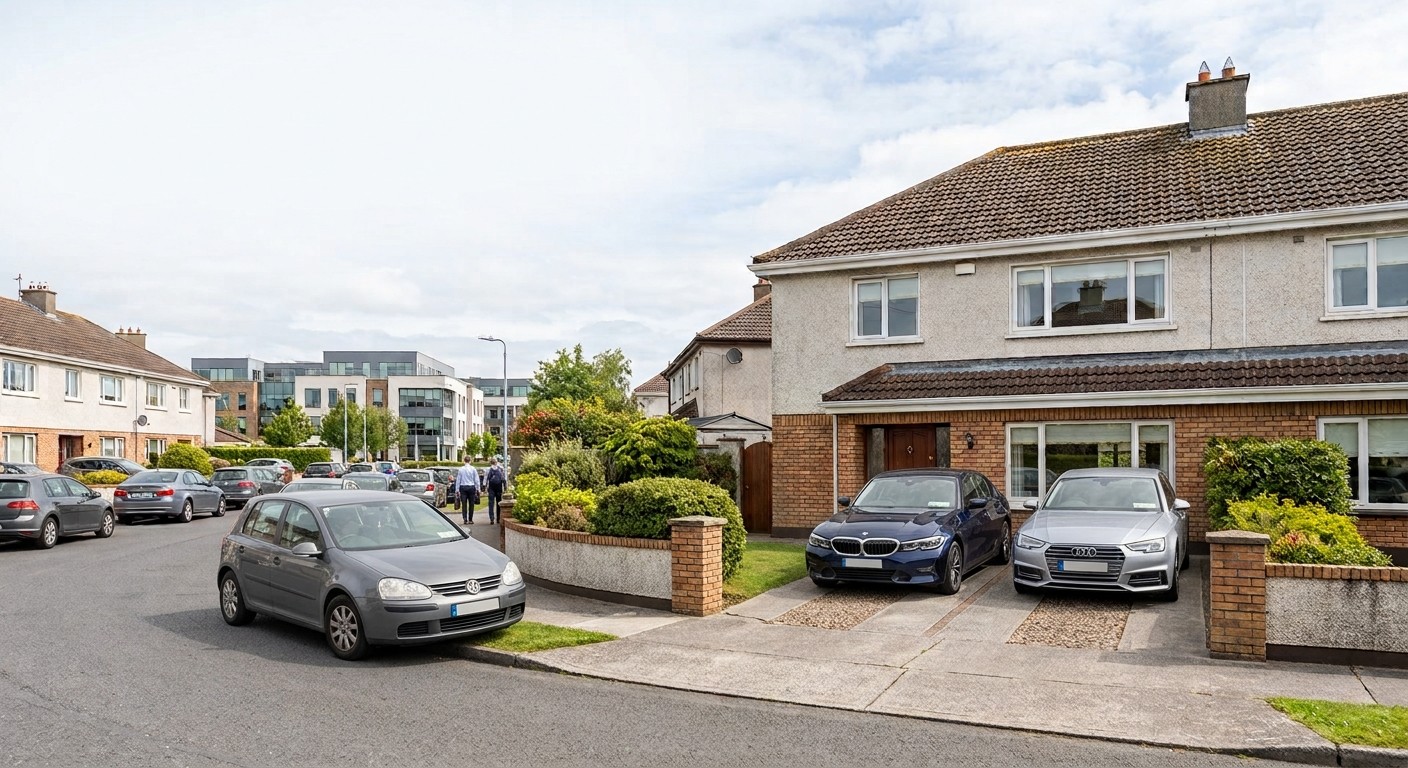
Your driveway is not worth money because it is a driveway. It is worth money because of where it is.
Two houses can have the same paving, the same gate, the same width. One space is worth fifty euro a week and the other is worth nothing at all. The ground is identical. What differs is what sits within walking distance of it.
That is the whole thing, and it is worth sitting with, because it inverts how people usually think about property. Most of what a house can do depends on the house — how big the garden is, which way the roof faces, what the walls will take. This depends on the map.
Two Irish homeowners have already shown what that looks like.
A woman in Santry has been letting her driveway to Dublin Airport passengers since 2019, at about fifty euro a week — roughly half what the airport charges. She is also close to Beaumont Hospital, where parking is expensive and scarce. A Dublin homeowner told the Irish Times in 2023 that she lets her space at thirteen euro a day, or sixty-five a week. She started because people kept parking across her frontage anyway.
Neither of them built anything. Neither of them bought anything. The value was already there, in the ground in front of the house, and it had been there the whole time.
And here is the part that makes this a property fact rather than a market fact. Location is the one thing about a house you cannot add, cannot improve and cannot lose. It transfers entirely with the deeds. If your driveway is worth something today, it will still be worth something to whoever owns it next.
Nobody had ever asked to use it.
Why Now
Why does this come up now?
Because the shortage is now well documented, and because the asking finally became easy.
Dublin Airport’s car parks are regularly fully booked. The Irish Times reported in 2024 that the overflow was putting pressure on the estates nearby — with residents describing ambulances that could not get through. In 2025, Dublin City Council was considering a pilot scheme to discourage what it called increasingly problematic match day parking on the residential streets around Croke Park.
Hospitals, stations and stadiums generate the same pressure on a smaller scale, every week, in a lot of ordinary places.
What changed is not the shortage. It is that a parking marketplace now operates here, and both of the main property portals list parking spaces. Ten years ago, letting your driveway meant knowing somebody who needed it. Now it does not.
One thing to be honest about, because it is the same story from the other side. The pressure that makes your driveway valuable is being reported as a nuisance. Councils are discussing how to reduce it. Residents near the airport are not describing an opportunity — they are describing blocked roads. Both of those things are true at once, and a road that is already tense about parking is a road to think carefully on.
Today
What can you do today?
Three routes. They are not three versions of the same thing — each one is opened by a different fact about your property, and it is the property that decides which, if any, is available to you.
If the space is empty on weekdays — regular parking
The simplest of the three, and the one most houses can do.
A commuter, a shift worker or somebody working nearby takes the space while you are out, by the day, the week or the month. You set the hours, the price and who is allowed. Nothing is built and nothing is fixed. If you stop enjoying it, you stop.
It earns the least, and it is the easiest to stop.
If you live within walking distance of somewhere people must reach — premium parking
An airport, a hospital, a stadium, a station, a busy town centre.
Same driveway, same arrangement, materially more money — because the alternative your driver is comparing you against is expensive. The Santry example is the clearest version: half the airport’s price, and still several times what the same space would earn a mile further out.
Walking distance is the whole test. If somebody would not walk from your gate to the thing, this pathway is not open to you, however close it looks on a map.
If you have off-street parking and a supply that will take a charger — EV charging
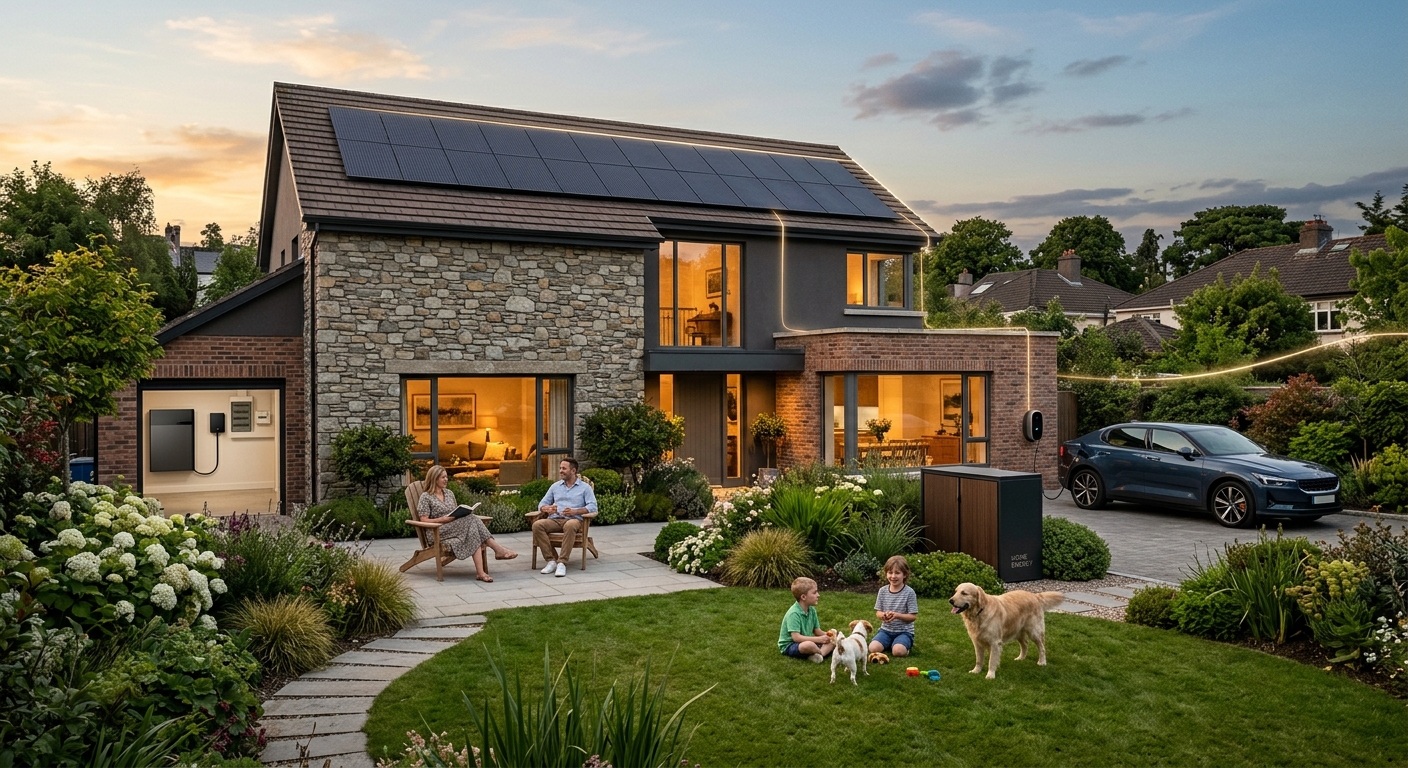
The secondary pathway, and the only one that changes the property.
A home charger is fixed to the house, needs an electrician, and is worth doing on its own terms. SEAI offers a grant of up to three hundred euro towards one. You do not need to own an electric car to claim it, but you do need off-street parking — and the grant is once per address, not once per person. If a previous owner claimed it, it is gone.
For this Discovery the relevance is narrower than it first appears: a space with a charger is worth more to the right driver than a space without one. That is a real difference, and it is still a smaller one than moving your house closer to an airport.
Day to Day
What does it change day to day?
Less than you would expect, and one thing more than you would expect.
Most of the time you will not meet the driver. A car arrives while you are out and is gone before you think about it. There is no key, no meeting, no conversation. The booking platforms handle the money, so nobody hands you cash at the door.
Nothing about the house changes. Nobody comes inside.
What changes is that the front of your house is in use when you are not there — and your neighbours will notice that before you do. A car they do not recognise, parked outside a house they do. On most roads that is nothing. On a road that is already short of parking, it is a conversation, and it is better to have it early than to be surprised by it.
Before You Start
What should you think about before you start?
Start with where you are, because that decides most of it.
Is there anywhere people are trying to get to within walking distance of your gate? If there is not, this Discovery is not for your house, and that is a perfectly good answer to have early.
Then the practical ones. Can a stranger reach the space without going through the house or past a window you would rather they did not? Can a car get in and out without a three-point turn into traffic? Is the space actually free when you would be letting it, or is it free only in theory?
Then planning, tax and insurance.
Planning — and this one has no Irish answer. The exemption that covers a driveway is for a hard surface, to the front or side, for parking not more than two cars, used for a purpose incidental to the enjoyment of the house as such. That last phrase describes domestic parking. Whether a stranger paying to leave a car there is still incidental to your enjoyment of the house has never been publicly determined in Ireland — we could find no guidance, no published declaration and no enforcement case either way. In England the government issued guidance that letting a single space normally needs no permission where it causes no nuisance, while turning a garden into a car park does. That is English guidance and it does not apply here. If you want certainty for your own address, a Section 5 Declaration from your local authority is how you get it.
Tax — this is income, and Revenue treats it as such. Parking income is taxable and must be declared. If your net non-PAYE income is under five thousand euro it goes on a Form 12; at five thousand or more you register for self-assessment and file a Form 11. Rent-a-Room Relief does not apply. That scheme is for residential accommodation in your home, and a parking space is not accommodation, so the fourteen-thousand-euro tax-free allowance people often assume covers this does not.
Insurance — tell your insurer before, not after. Earning money from the property is a change of circumstances, and not declaring it can give an insurer grounds to void a policy. Ordinary buildings and contents cover is not written for letting space to the public, and the real exposure is liability rather than damage: somebody slipping, falling or hitting something on your ground. Ask your own insurer directly what they will and will not cover.
And what you are willing to be asked. How often, at what hours, which vehicles, and who you would rather not have calling. It is your gate. You choose, and you can change your mind.
PlotNua does not arrange this, does not take a share of it, and cannot tell you what your driveway is worth.
Looking Ahead
Looking Ahead
Everything above can be done in Ireland today. What follows cannot.
Nothing comparable here yet
The obvious next step would be your driveway becoming part of something larger — a car club vehicle kept on it, a shared car for the road, a small hub for something other than parking.
That does not exist here. Car sharing in Ireland is fleet-based: the operators keep their own vehicles in their own bays, and none of them uses residential driveways. We could find no Irish service of any kind that pays a householder to host anything on their drive except a parked car.
What would have to change
What is missing is not demand. It is a company willing to do it.
Somebody would have to decide that a thousand ordinary driveways in the right places are worth more than a hundred bays in the wrong ones. Nobody has, and until somebody does, this is a paragraph about a thing that does not exist.
Your location will not change
None of that changes the basic point.
Your driveway is close to what it is close to. That was true before any platform existed and it will be true after. The value is in the ground and the map, not in whoever happens to be arranging the introduction this year.
Frequently Asked Questions
Questions this Discovery tends to raise.
Do I need planning permission to rent out my driveway?
Nobody in Ireland has published an answer. The exemption for a driveway covers a hard surface for parking not more than two cars used for a purpose incidental to the enjoyment of the house — and whether paid parking for a stranger is still incidental has not been determined here, in guidance or in a published case. In England, the government’s position is that letting a single space normally needs no permission where there is no nuisance, but that is English guidance. A Section 5 Declaration from your local authority is how you get a determination for your own address.
Do I have to pay tax on it?
Yes. Parking income is taxable and must be declared. Net non-PAYE income under five thousand euro goes on a Form 12; five thousand or more and you register for self-assessment and file a Form 11.
Does Rent-a-Room Relief cover it?
No. That scheme is for residential accommodation in your home. A parking space is not accommodation, so the fourteen-thousand-euro allowance does not apply here.
What will it actually earn?
That depends entirely on where you are, and there is no Irish dataset. What we can tell you is what two Irish homeowners have said publicly: about fifty euro a week beside Dublin Airport, and thirteen euro a day or sixty-five a week in Dublin city. A driveway with nothing within walking distance earns nothing, whatever a platform’s headline says.
Do I need to tell my insurer?
Yes, before you start. Earning money from the property is a change of circumstances, and not declaring it can give an insurer grounds to void the policy. Ordinary home cover is not written for letting space to the public. Ask yours directly.
What will the neighbours think?
Ask them first, particularly if your road is already short of parking. A car they do not recognise outside a house they do is noticed. On most roads it is nothing; on a tense road it is worth a conversation you start rather than one you are handed.
How would someone find my space, and how would I get paid?
There are a few ways to do it.
Through a parking marketplace. You list your driveway, choose when it is available and set a price. A driver finds the space, books and pays through the platform, and the platform pays you. YourParkingSpace currently offers this service in Ireland.
Through a classified ad. Daft.ie and Rent.ie both list parking spaces, but they do not handle the booking or payment. You arrange that directly with the driver.
Privately. You can also make an arrangement directly with someone who works or lives nearby.
PlotNua does not currently list parking spaces, take bookings or handle payments.
Is the EV charger grant worth claiming?
It is up to three hundred euro from SEAI towards a home charger, you do not need to own an electric car to claim it, and you do need off-street parking. Two things to know: it is once per address rather than once per person, so a previous owner may have used it — and a charger makes a space more attractive to some drivers, but it will never matter as much as where the space is.