The Money
What might you be paid?
There is no Irish day rate, and anyone quoting you one is guessing. What exists is a handful of real, attributed examples — and they are very far apart, because the circumstances are very far apart.
-
Two hours, exterior only, typical mid-terrace house
around €500
a working location manager
-
An eight-hour day with a smaller crew — the ordinary advertising and content shoot
€700 – €1,500
an Irish locations platform
-
A television drama or feature, per day
€500 – €1,000
attributed to Wicklow Film Office
-
A large house in Killiney, per week
€10,000 – €20,000
a working location manager
-
A house on Achill used for twelve weeks, owners moved out
around €30,000 in total
the homeowners
Read the first row and the last row together. They describe the same market and almost nothing else in common.
Two things that shift the figure: where you are — Dublin and Wicklow are in more demand and can command more — and how much of your life the production needs. Fees are negotiated directly between you and the production.
One thing to watch: the hourly rates you see on a locations platform are the rates a production pays to book, before VAT and before whatever the platform takes. They are not what lands in your account.
Questions
The practical questions
Does my house have to be nice?
On the evidence, no. What is described as decisive is character and practicality — parking, access, storage, power, toilets — rather than how impressive the house is. One Irish platform says personality matters more than valuable furniture.
Do I have to live somewhere else?
Sometimes. One location manager says it is preferable that owners move out for the duration, even for a few days. Where that happens, bigger-budget productions factor alternative accommodation into the payment.
Can I say no to parts of it?
Yes. Rooms can be put out of bounds, changes are agreed in advance line by line, and where relevant you may be sent the script so you can see what is being filmed.
What happens to my insurance?
This is not established. PlotNua found no authoritative Irish source on how household insurance treats commercial filming, and it will vary by policy. Check with your own insurer before agreeing anything.
Is the money taxable?
Income is taxable and has to be declared. What PlotNua could not establish is which category a location fee falls into — Revenue publishes
guidance on rental income but nothing specific to location fees.
That is a question for Revenue or your own adviser.
Does this need planning permission?
Not established. PlotNua found no Irish source on whether repeated commercial filming at a private home engages planning as a change of use. If you were thinking about doing it often, that is worth asking your local authority.
What does an agency take?
Not published. No Irish location agency PlotNua checked publishes its commission. Ask before you list.
What if my house is rented, or I share the title?
The national register asks whether you are the owner, a tenant or an agent, and asks you to confirm you have authorisation. If you are not the sole owner, that is a conversation to have first.
Looking Ahead
Looking Ahead
Everything future-facing on this page is in this section and nowhere else.
What makes this hard for a homeowner is not the idea. It is that the qualifying questions are practical ones nobody has ever asked them: can a van park here, is there a way in that avoids the house, is there somewhere dry to leave equipment, could you leave for three days.
Those are answerable. A future version of PlotNua could ask a small number of questions like that and tell you honestly whether your property clears the practical bar that location registers actually test for — and, just as usefully, where it plainly does not.
That does not exist yet. Nothing on this page assesses your property.
Evidence
The evidence behind this
Where this page states something, it is because a named source states it. Where no source could be found, the page says so rather than filling the gap.
The national and local registers — read directly
Screen Ireland — Locations Database. The national development agency operates a Locations Database with a public “Register a Property” route. The registration form runs to seven sections, states approximately twenty minutes, and asks for “as much information and as many images as possible”. It requires an Owner / Tenant / Agent declaration and a separate authorisation confirmation, and it requires an Eircode and a county; the county list covers all twenty-six and the nearest-town list runs to several hundred Irish towns. Its public browse categories are Action & Adventure, Fantasy, Science Fiction, Horror, Period Britain, Historical Drama, Studio Sets and Hidden Gems. There is no ordinary-homes category. Read 24 September 2026.
Wicklow Film Office — homeowner location form. Owned and operated by Wicklow County Council, running its own location library with its own homeowner registration form. The form asks for a property description, a location category, storage areas (dimensions, secure, weatherproof), parking, and restrictions — its own example being “open to the public or property in use Sunday mornings”. It states: “Please note that locations added without corresponding images will not be approved.” Its fourth declaration states that the office “will not have any liability to the location owners for any loss, damages, costs or expenses… as a result of any arrangements the location owner may make with third parties introduced through Wicklow Film Office”.
Superseded, and recorded here rather than removed. That form is the older Wicklow County Council document. The office’s current site, read 25 September 2026, describes something different: it directs people to browse the Screen Ireland database, and asks anyone who wants a location added to contact the office. The page above follows the current position. The older document is kept in this drawer because it is what a homeowner may still find, and because it is where the liability wording quoted here comes from.
How ordinary homes are actually found — named practitioners
Reported in national press, 20 July 2025, and attributed there by name.
Peter Conway, location manager. For “ordinary” properties he identifies a street the production team agrees on and does a letter drop, then follows up on responses. On matching non-Irish settings: “Because we service a lot of TV shows set in the UK or in America, it can be a challenge trying to match American architecture.”
Stephanie O’Sullivan, SoScout. “What clients are looking for is as much variety as possible, and that the home has personality… Personality takes precedence over valuable furniture. It is something that can’t be created.” SoScout’s main business is content creators and production companies working for advertising agencies. It lists roughly 150 homes, and was founded because its founders found no Irish locations website existed.
What the money looked like in named cases
Every figure below is bound to the scenario it was given for. None of them is a rate card, and no Irish rate card was located.
Around €500 — a two-hour, minimally invasive exterior shoot at a typical mid-terrace home, described by location manager Mick Swan as something that “might only net you €500”.
€700 – €1,500 — an average shoot of an eight-hour day with smaller crews, per SoScout.
€500 – €1,000 per day — TV drama and feature, attributed to Wicklow Film Office.
€10,000 – €20,000 per week — a Killiney mansion, per Mick Swan.
“In the region of €30,000” — Currane House, Achill, for twelve weeks in total with the owners moved out, per the named homeowners.
Fees are negotiated directly between homeowner and production. Dublin and Wicklow are more in demand and can command higher fees. Where the homeowner must move out, an amount for alternative accommodation is factored in, “at least on bigger-budget productions”.
Platform listing rates are a different thing entirely. SoScout listings show roughly €113 – €162 per hour plus VAT on eight-hour bookings. Those are gross booking rates before VAT and before the platform’s own share. They are not homeowner earnings and are not presented as such anywhere on this page.
What homeowners were told — named practitioners
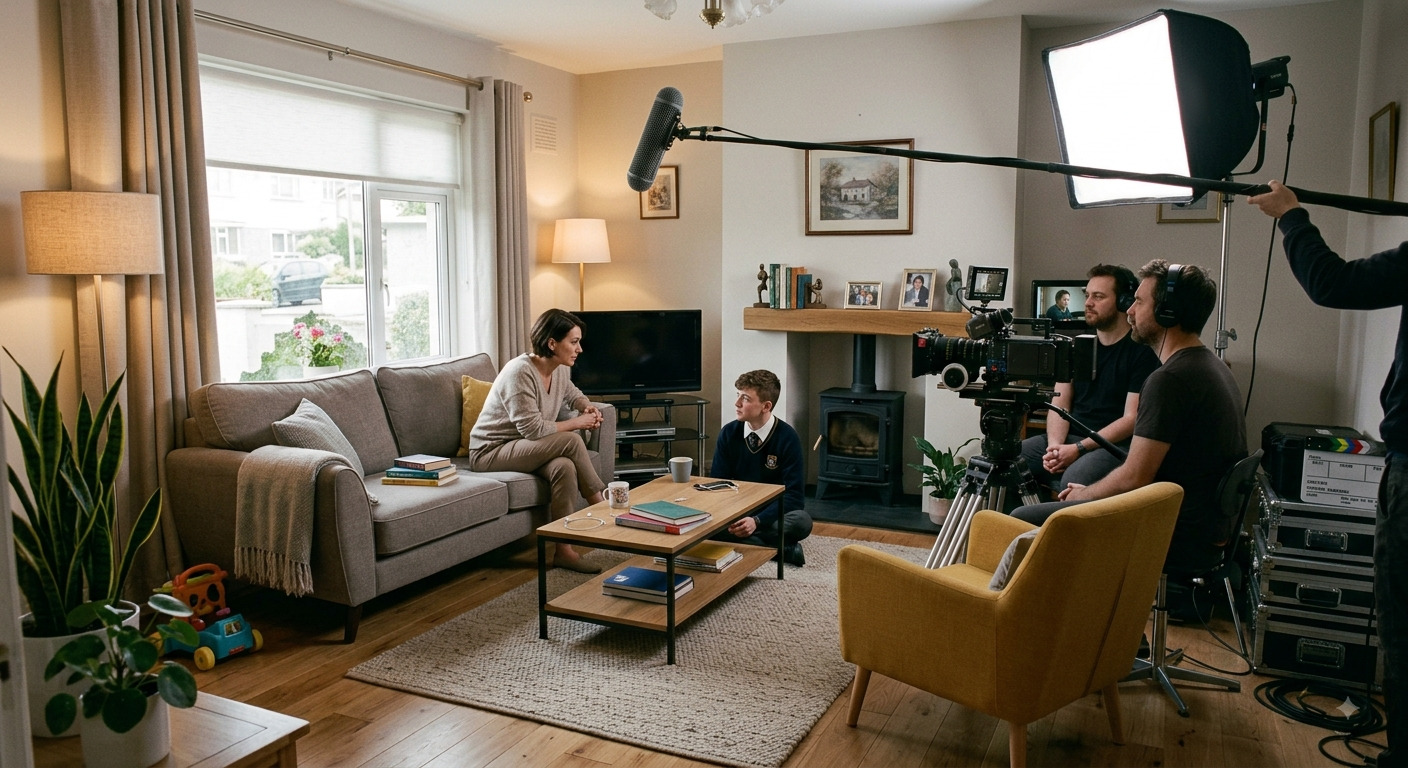
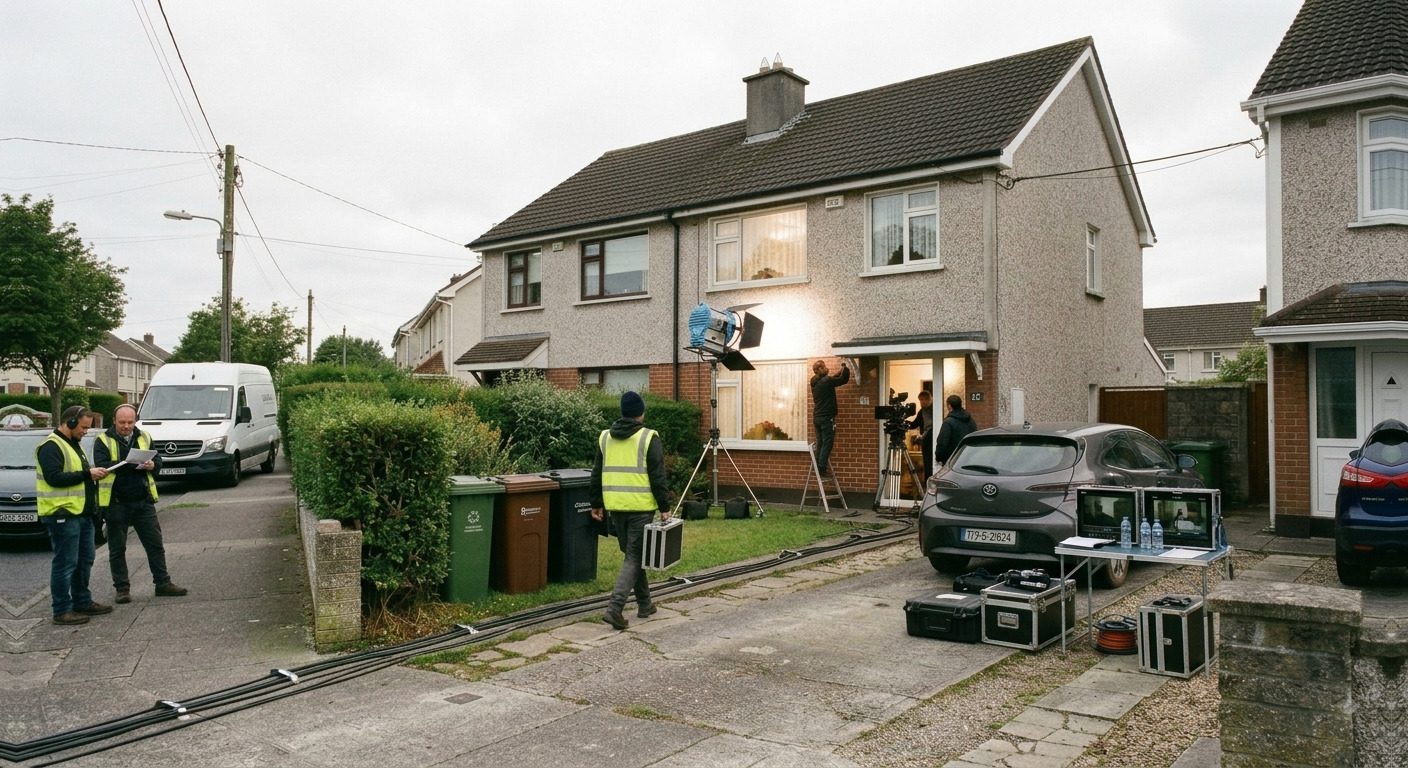
Peter Conway: “It is the most private space and it needs a level of trust to give over your home to film and TV production.” “There will be equipment and people all over the place. On bigger productions there can be up to 200 people on set.” He says it is preferable that people move out for the duration, “even if it’s only for a few days”, and that “people with young kids might find it too disruptive.” Location managers go through all the changes they want to make line by line before anything happens.
Mick Swan makes owners aware of which rooms will be used and for what, and “will send them a script to flag scenes depicting anything they might consider offensive or controversial, such as horror or violence”. He notes “there can be multiple visits from crew even before they decide to use your home” and that “it’s not money for nothing. You have to sign a contract agreeing to the terms and read all the emails.”
Liz Allen describes home location filming as “massively invasive”: “You have to protect the house, the crew and the equipment.”
Currane House, Achill. Four weeks of art-department pre-production, six weeks of filming, one to two weeks to strip out. The owners were told which rooms to leave “as is”, and “some of the rooms were not to be used at all.”
On restoration. Location managers say everything is put back exactly as it was. That is a practitioner statement about how those individuals work. It is not a verified contractual standard, and it is not a guarantee.
SoScout profiles specify power access, parking, wifi and WCs.
What this evidence does not establish
Insurance. How household insurance treats commercial filming is not established. It is per-policy. Production insurance standards in Ireland are not established either.
Planning. The planning treatment of repeated commercial filming at a private home is not established. No Irish source was located.
Tax. The tax classification of a location fee is not established. Revenue publishes rental-income guidance; no location-fee-specific guidance was located.
Agency commission. Not published by any Irish agency checked.
Contract terms. Cancellation terms, preparation and strike rates, overtime and security deposits are not established.
Conversion. No Irish data is published on how often a listing leads to a booking.
And four things this page will not let itself imply. That Screen Ireland seeks ordinary homes — its own categories say otherwise, and the evidence for ordinary homes comes from practitioners. That listing leads to selection — nothing published supports that. That restoration is contractually guaranteed — it is a practitioner account. And that PlotNua can put a property forward — it cannot, and it is not a location agency.