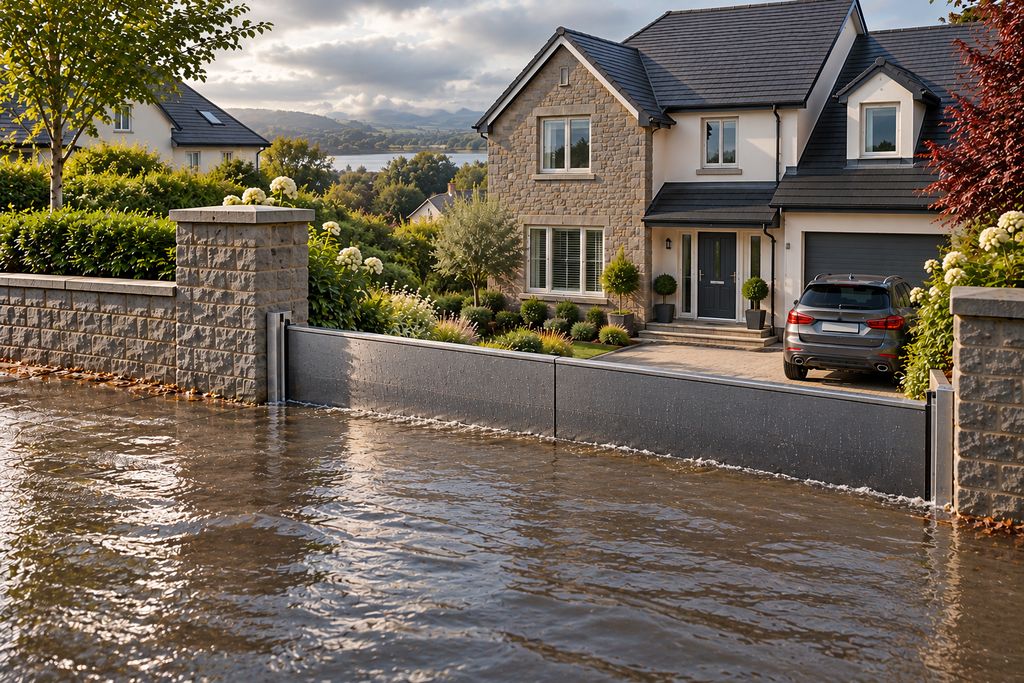
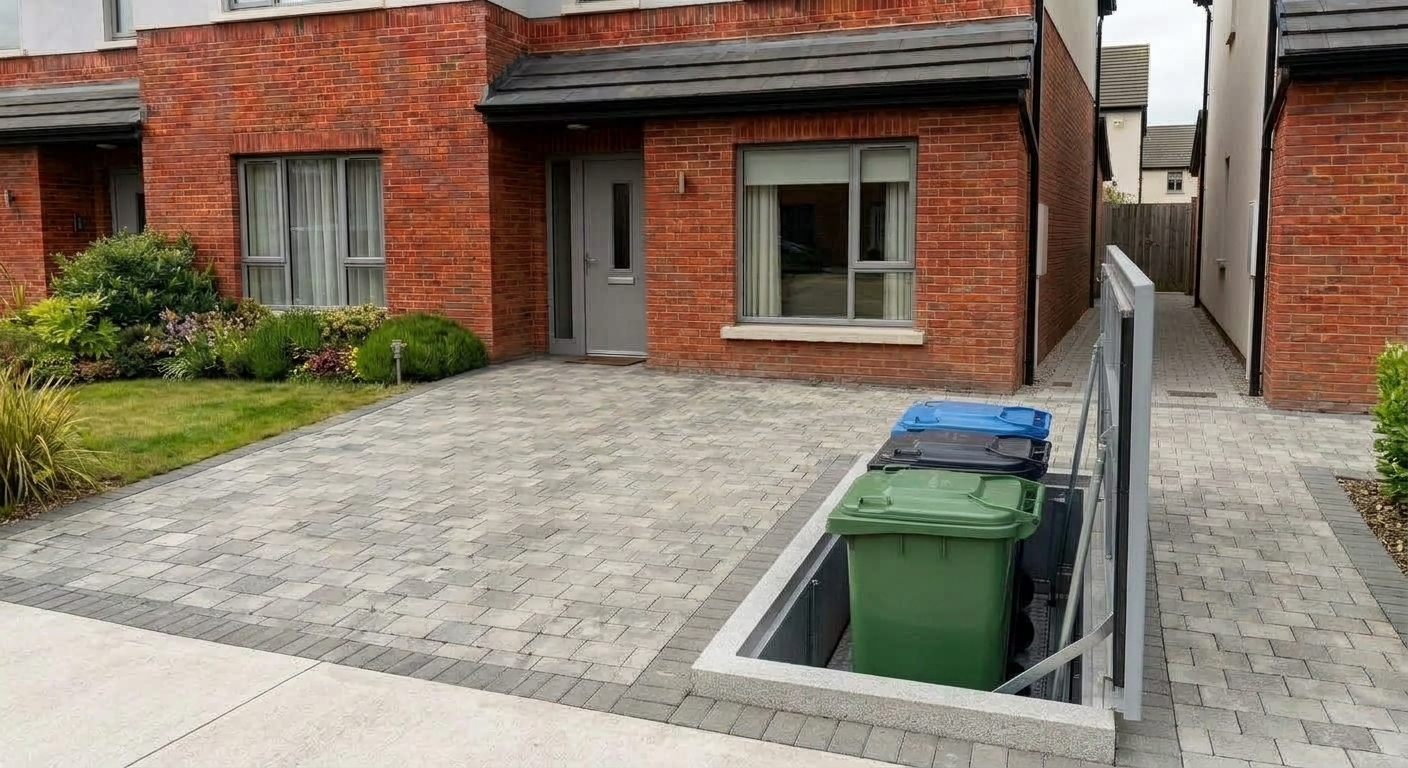
Slide to compare.Drag the handle, or use the arrow keys, to compare.Use the left and right arrow keys to move the divider. Home shows the barrier risen against floodwater; End shows the driveway on an ordinary day.
Illustrative AI-generated visualisation. Not an actual installation.
A PlotNua Discovery
The Hidden Flood Barrier
What if your driveway could help keep floodwater out, even while you’re away?
Some flood barriers lie flat in the ground until water arrives, then the water itself lifts them into place. They’re real, and they’re already used at homes abroad. Here’s how they work, what they can’t do, and what’s available in Ireland today.
Illustrative AI-generated visualisation. Not an actual installation.
The possibility
An ordinary driveway, most days of the year.
Most of the time, you’d never know it was there. A strip of paving at the entrance, a narrow grate beside it. You drive over it, the bins go out over it, the bikes are left on it.
Then one evening the rain doesn’t stop, the road starts to run with water, and it begins to reach the entrance. Nobody needs to be home. Nobody needs to find the barrier in the shed, or remember how it fits.
The water does the work.
01The way in. Water follows the easiest route. Here, that’s the wide, open entrance.
02Hidden in the paving. A slim strip and a grate, just inside the piers, are all you’d see.
03The street side. The footpath and road, where floodwater would arrive first.
The illustrations show an imagined house. PlotNua hasn’t assessed this or any real property.
01 · How it works
The water does the lifting.
Some flood barriers lie flat in the ground until floodwater arrives. The water flows into a basin beneath them and lifts them into place, with no power or person needed.
One thing to know from the start: the barrier needs no power to rise, but its basin must drain, and in some sites that needs a pump, which needs electricity.
Simplified diagram, not to scale
Dry. On a normal day the barrier lies flat in its basin. You can drive over it.
1
Lying flat. On a normal day, the barrier is a flat panel set into a shallow basin just inside the entrance. You can walk and drive over it.
2
Water arrives. When floodwater rises to a set level, it flows into the basin through an inlet on the road side.
3
Floating up. The panel is buoyant. As the basin fills, it floats upward and swings up on a hinge.
4
Held in place. Once it’s upright, the water pressing against it pushes it onto rubber seals, which helps it hold.
5
Back down. When the flood goes down, the basin drains and the panel settles back flat.
A simplified illustration of the general principle. Real systems differ in design, depth, drainage and maintenance. Some rise straight up rather than on a hinge. Every one needs a site survey.
DrainageWhere the water goes afterwards
The basin has to drain. Every self-rising barrier sits in a basin, and the water that lifts it must go somewhere once the flood passes. Usually it runs by gravity through a pipe to a surface-water drain, or to a soakaway designed for it.
And in heavy rain, the public drains can themselves be full. That’s exactly when the barrier is working. So ask your engineer about non-return valves, which stop water flowing back the wrong way, or about a pump.
Simplified diagrams. Your engineer decides the arrangement for your site.
PowerWhen electricity comes into it
The barrier itself needs no power to rise. But where the basin can’t drain by gravity, a pump may be needed to empty it, and a pump does need electricity. So “no power needed” is true of the lifting, not always of the whole system.
Any pump wiring must be done by a Registered Electrical Contractor, who should give you a Completion Certificate.
MaintenanceIt needs looking after
They hold back water only up to their own height, and they need regular inspection and maintenance. Silt, leaves and grit can collect in the inlet and the basin, and seals wear over time. Ask how the barrier is test-lifted, how often, and who in Ireland would service it.
02 · Already working abroad
Not a prototype.
Illinois, USA
A driveway gate, 2007
Manufacturer’s case study
At a private home in Illinois, USA, a self-rising gate was installed across the driveway in 2007 (manufacturer’s case study). The house sat in a dip, and heavy rain had repeatedly sent water from the street down the drive. The gate was finished to match the paving.
South Carolina, USA
A historic house, 2025
Manufacturer’s case study
In 2025 a similar gate was installed at a historic home in Charleston, South Carolina (manufacturer’s case study).
Antwerp, Belgium
The same idea at city scale
Public waterfront
In Antwerp, an 842-metre self-closing barrier is being built along the river Scheldt; a section was tested at the Deltares research institute in 2024. It stays hidden underground, so the quays stay open, and rises only when the water does.
The two home examples are described from the manufacturer’s own published case studies, and haven’t been independently verified. No project photographs are shown. Inclusion doesn’t mean a manufacturer is available in Ireland or connected with PlotNua.
03 · In Ireland today
Ahead of the market here.
We haven’t found a self-rising flood barrier installed at a home in Ireland yet.
At least one manufacturer that makes self-rising barriers has supplied flood barriers in Ireland, but domestic installation here hasn’t been confirmed.
So for now, this is a specialist idea rather than something you can order. Every installation is designed for its site: the width of the entrance, the depth of the basin, where it drains, and the services under the ground. If you’re interested, the first step is a survey, not a catalogue.
04 · The practical option today
If you need something sooner.
Removable flood barriers, made to measure, are made and installed in Ireland.
They work differently. Permanent posts or channels are fixed either side of an opening, a door or the space between gate piers. When a flood is forecast, you slot the barrier panels into them. They’re simpler and far more established. But someone has to be there, in time, to put them up.
In some areas, such as Midleton and East Cork, local authorities have run Individual Property Protection schemes for homes that have flooded. Ask your local authority whether one applies to you.
What it can’t do
One opening, not the whole house.
A barrier at the driveway protects one opening. Floodwater can also come in through drains, airbricks, walls and floors, or rise as groundwater.
No barrier is a guarantee: water can rise above it, find another way in, or get past one that isn’t maintained.
A barrier is only as good as what’s beside it. If water can come around the side, over a low wall or through a gap in the hedge, the barrier won’t stop it. The wall, the barrier and the house have to be thought about together.
Before you go further
The practical side, early.
Flood risk
Start with your flood risk
Check your flood risk first, using the OPW’s flood maps at floodinfo.ie and the GSI’s groundwater flood maps. A map is a starting point, not a guarantee: flooding can come from more than one source.
Planning
Check before you build
Planning rules can apply to flood barriers, depending on their design and location. Check with your local authority, or ask it for a Section 5 declaration, before you build.
At the footpath
The council’s ground
Any work into the public footpath or kerb needs the council’s consent, usually through a licensed contractor.
Drainage and power
Where the basin drains
The basin has to drain. In heavy rain the public drains can themselves be full, so ask your engineer about non-return valves or a pump. Any pump wiring must be done by a Registered Electrical Contractor.
Insurance
Talk to your insurer
Talk to your insurer before relying on any barrier. Insurers make their own decisions, and an OPW-backed scheme notes that floodgates may not be recognised for insurance.
Maintenance
Who will check it?
Ask who will inspect and test the barrier, how often, and what servicing is available in Ireland. A barrier that hasn’t been checked can’t be relied on.
NeighboursShared walls and neighbouring homes
In semi-detached and terraced houses, water can travel between homes. Talk to your neighbours about flood protection; it works best done together.
What does it cost?
Priced for the site, not off the shelf.
There’s no published Irish price. Self-rising barriers are made and installed to suit each site, so expect a significant specialist project and ask for a site survey and quotation.
We’d rather tell you that than print a figure we can’t stand behind.
Last checked 27 October 2026. PlotNua is an independent discovery platform and does not recommend or endorse any manufacturer or supplier mentioned. Nothing on this page is engineering, planning or insurance advice. The images on this page are AI-generated illustrations of an imagined home, not photographs of any installation.
The homeowner decision
Two ways to take the next step.
A
Explore the possibilities yourself
Explore flood-protection possibilities: how a self-rising barrier works, what’s available in Ireland, the removable option and what it can’t do.
PlotNua doesn’t sell or install flood barriers and can’t confirm how any product would perform at your property; a chartered engineer should assess your flood risk. Nothing is booked by starting a conversation.
Your next step
Start with your flood risk, not with a product.
Step 1
Check your flood risk
Look up your area on floodinfo.ie and the GSI groundwater flood maps, and ask your local authority what it knows about flooding on your road, and whether an Individual Property Protection scheme applies.
A chartered engineer can look at how water would reach your house, every route in, and whether a barrier at the drive makes sense, including how it would drain.
Step 3
Investigate suitable products
Then talk to suppliers, with that advice in hand: self-rising or removable, what’s available here, how it’s installed, and who would service it.
It helps to bring:
photos of the entrance, the driveway and the front of the house;
what happened in any past flood: where the water came from, and how high it rose;
the width of the entrance;
anything you know about drains or services at the front.