

Skip to main content Back
Chat on WhatsApp
Search PlotNua
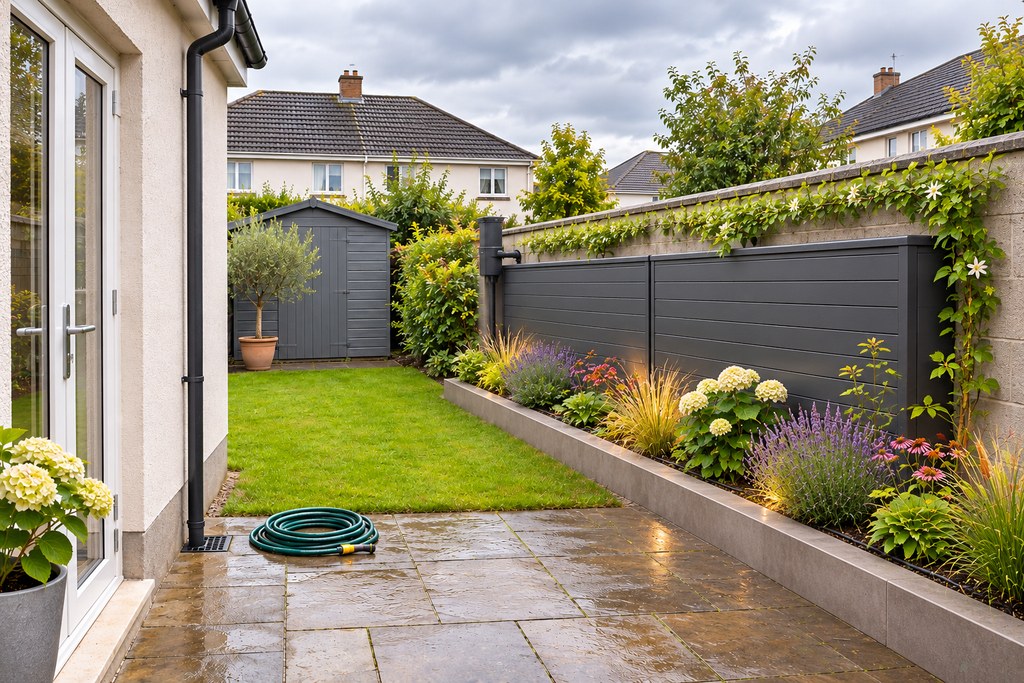
Possible: the same garden with a slim charcoal rainwater-storage wall of two panels standing in front of the boundary wall, a downpipe filter at its end, climbers trained above it and a raised planting bed in front.
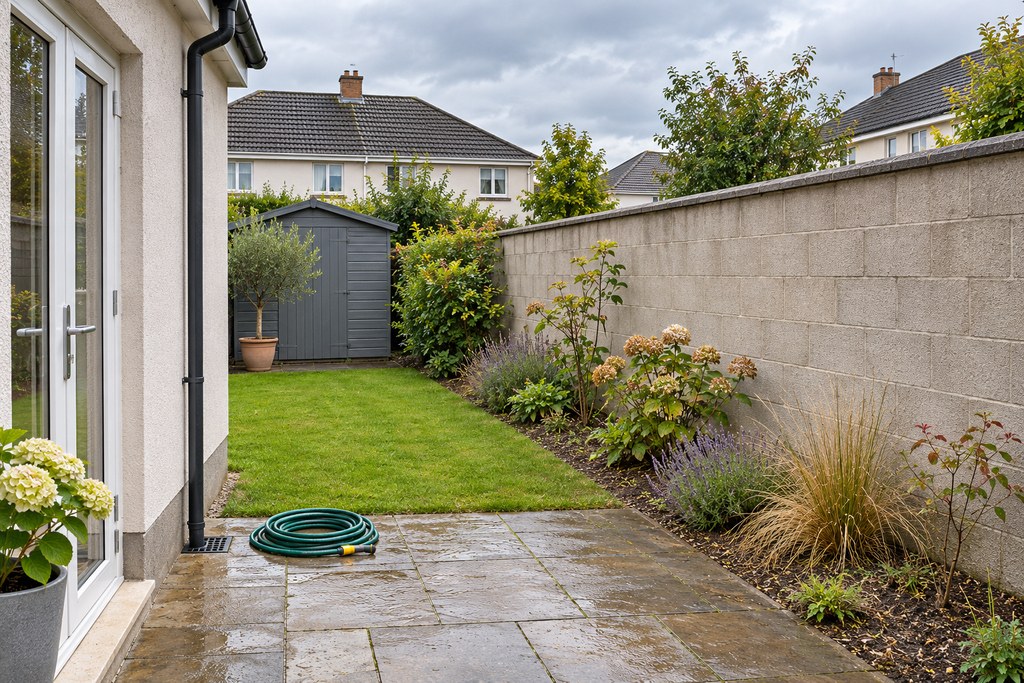
Before: an Irish suburban back garden after rain, with a rendered block boundary wall and a planted border along it, the house downpipe running into a drain, a coiled hose on the wet patio, a lawn and a grey shed.

Use the left and right arrow keys to move the divider. Home shows the garden with the storage wall; End shows the garden as it is today.

AI-generated illustration — not a real installation.

A PlotNua Discovery

The Water Wall

What if your garden wall could store the rain?

A slim storage wall can collect the rain from your roof and keep it for the garden, standing quietly along a boundary you already have.

AI-generated illustration — not a real installation.

The possibility

What if your garden wall could store the rain?

Rain falls on the roof. Most of it goes down the drain.

Every downpipe carries the rain from your roof straight to a drain. A few weeks later, in a dry spell, the same garden is watered from the tap.

A rainwater-storage wall keeps some of that water. It is a tall, slim tank, about the depth of a garden bench, that stands along a boundary or the side of a house and fills from the downpipe. Its face can be planted, screened or simply left as a clean, dark plane.

The idea

More than a water butt.

A water butt holds enough for a few watering cans. A storage wall is a different scale of idea: about a thousand litres in a single slim panel, and a boundary that does a job.

A water butt and a storage wall compared

  • 100–650 L

    A water butt or slimline tank

    The familiar answer: a tank on a stand beside a downpipe, with a tap at the bottom.

    Holds
    Usually 100 to 350 litres; slimline wall tanks reach about 650 litres.
    Space
    A corner beside the downpipe.
    Fitting
    A diverter kit on the downpipe; often a weekend job for a confident DIYer.
    In Ireland
    Widely sold by garden centres and online.
  • ABOUT 1,000 L A MODULE

    A rainwater-storage wall

    A tall, slim tank designed to stand along a boundary or a façade, or as a screen in its own right.

    Holds
    About 1,000 litres in a panel about 30 cm deep, according to makers; panels can be linked. Maker claim
    Space
    A side passage, a rear boundary, beside a shed or garage, or as a screen.
    Fitting
    A prepared footing, fixings and a downpipe connection: work for an installer, with an engineer where needed.
    In Ireland
    Not confirmed as available through an Irish distributor. See chapter 05.

Illustrative drawings by PlotNua, not to scale and not designs for any garden.

The idea isn’t a bigger water butt. It’s a boundary that collects the rain.

How it works

From the roof to the flower bed.

The principle is the same as any rainwater tank. What changes is the shape: the storage becomes part of the garden’s architecture.

How a rainwater-storage wall works

How a rainwater-storage wall works. Not to scale. Rain falls on the roof and runs into the gutter. The downpipe carries it to a filter that takes out leaves. Clean water flows into the storage wall, which stands on a footing beside the house. When the wall is full, the filter sends the extra water on down the downpipe to the drain. A tap or a small pump at the base feeds a drip line in a raised planting bed. 1 Roof1 mm of rain on 1 m² ≈ 1 litre 2 Gutter and downpipe 3 Downpipe filterleaves and debris out 4 Storage wallabout 1,000 litres a module 5 Overflowback to the drain 6 Garden irrigationtap, or a pumpand drip line Footing designed for about 1 tonne per module Garden use only: no mains connection NOT TO SCALE How a rainwater-storage wall works. Not to scale. 1 2 3 4 5 6 NOT TO SCALE
Illustrative drawing by PlotNua. Not to scale, and not a design for any garden.
  1. RoofRain falls on the roof. As a rule of thumb, 1 mm of rain on 1 m² of roof gives about 1 litre of water, a little less once some is lost to splash and evaporation.
  2. Gutter and downpipeThe gutter collects it and the downpipe carries it down, as it does today.
  3. Downpipe filterA filter or diverter on the downpipe keeps leaves and debris out and sends clean water to the storage.
  4. Storage wallThe water collects in the wall, which stands on its own prepared footing. A closed top keeps out light, children and leaves.
  5. OverflowWhen the wall is full, the extra water carries on down the downpipe to the drain, exactly as it does now.
  6. Garden irrigationA tap at the base fills a watering can or a hose. A small pump can feed a drip line to beds and pots.
Using the water

For the garden, not the kitchen

Stored rainwater suits watering beds, pots, vegetables and young trees, and washing tools or a bike. It isn’t treated, so it isn’t for drinking or cooking, and a garden-only system has no connection to the mains supply.

A tap and a watering can need nothing more. A pump that feeds a drip line or a timer needs power: where that means new outdoor wiring, use a Registered Electrical Contractor.

The practicalities

Is it right for your garden?

A full storage wall is heavy, tall and close to a boundary. That’s why a full-sized one is not a simple DIY project. These are the questions to settle first.

Before anything is ordered

What a storage wall asks of a garden.

What each point depends on is your site: the ground, the wall beside it, the drains and your neighbours.

Established

Physical facts and the rules that apply. Each item notes who should confirm it for your garden.

Weight when filled

About a tonne for every thousand litres

A litre of water weighs a kilogram, so a full 1,000-litre module weighs about a tonne, plus the tank itself, on a narrow strip of ground. That load has to be carried by a properly prepared footing, not by soil, paving or an old patio.

Structural support

A footing designed for the load

The base should be designed for the filled weight and your ground, by the installer or a structural engineer. Makers publish base requirements for their own tanks: follow them, and keep the paperwork.

The wall behind

An existing garden wall isn’t built to carry it

A typical block boundary wall is designed to stand up, not to carry a tank. A storage wall should stand on its own footing, with any fixing to a wall or posts designed for the purpose.

Wind loading

Stable when empty, too

Full, a storage wall is heavy. Empty, a panel about 2.25 metres long and 1.75 metres high is light and catches the wind like a fence panel. Anchoring and bracing should be designed for an exposed site, especially if it stands freely as a screen.

Drainage and overflow

The rain still has to go somewhere

In a downpour the wall fills quickly. The overflow must go back to the existing downpipe and drain or to a suitable soakaway, never onto a neighbour’s garden, a path or a wall. Check that the gutter and downpipe are sound before connecting anything.

Frost

Taps, pipes and pumps in winter

Irish winters are mild, but exposed taps, hoses and pumps can freeze. Many tanks have a low outlet for draining down, and many downpipe filters have a winter setting. Ask the maker what the tank itself is rated for.

Planning

Height limits, and a grey area

Garden walls and fences around a house are generally exempted development up to 2 metres high, or 1.2 metres in front of the house, subject to conditions. Whether a storage tank counts as a wall or fence isn’t settled. If in doubt, a Section 5 declaration from your local authority gives a formal answer.

Shared boundaries

Talk to your neighbour first

On or against a shared boundary, agree it with your neighbour before anything is built, including access for the work and for maintenance. Where the boundary wall itself is shared, it isn’t yours alone to load or alter.

Confirm individually

Practical guidance. The answers depend on your garden and the product.

InstallationWho should install it

For a full-sized storage wall, plan on professional installation: a landscaper or groundworker for the footing, the maker’s installation guidance for the tank and its fixings, a structural engineer where the load, the ground or the wind exposure calls for one, and a Registered Electrical Contractor for any pump wiring. Ask the maker whether its warranty depends on professional installation.

Roof areaWill it fill?

The roof area that drains to the chosen downpipe, multiplied by the rainfall in millimetres, gives a rough idea of how many litres could be collected. A large wall on a small roof may rarely fill; a small one on a big roof will overflow often. Your installer can size it to the roof.

SafetyChildren and pets

Choose a fully closed tank with a secure lid or no open top. Even a small depth of water is a drowning risk for a young child.

UpkeepLooking after it

Clear the gutter and the downpipe filter regularly, especially in autumn, and leave room to reach the filter, the tap and any pump. A closed, dark tank helps keep algae down.

MoneyWhat it won’t do

Irish households don’t currently pay domestic water charges, so a storage wall shouldn’t be expected to reduce a water bill. Its value is in having water for the garden through dry spells, watering plants with rainwater, using less treated water outdoors, and a boundary that does a job.

What exists today

What’s out there?

Rainwater-storage walls are made and sold in Europe. Here is what PlotNua found, with the prices those sellers advertise.

Rainwater-storage walls and slimline tanks

In Ireland

Not yet confirmed through an Irish distributor.

When PlotNua checked on 4 November 2026, we couldn’t find an Irish distributor or installer offering a genuine rainwater-storage wall. That may change, and PlotNua can’t say if or when. What you can buy in Ireland today are slimline wall tanks, shown last below.

Harves · Europe

The Rainwater Wall

A modular storage wall: about 1,000 litres in a module about 225 × 175 × 30 cm, which can stand along a façade, as a rainwater fence or on its own. A filter and brackets are included. It is sold through dealers in several European countries; Ireland is not among those it lists. Maker claim

€1,050–€1,099 for one moduleRecommended price in the Netherlands and Belgium, including 21% VAT. Delivery, pump and installation extra. Advertised figure, checked 4 November 2026.


ThinTanks · sold in Germany

Thin wall tanks

An Australian design of very slim tanks for walls, fences and side passages. The 1,000-litre tank is about 2.4 metres long, 26 cm deep and 2 metres high, and the maker says it must stand on a solid base or slab. A German retailer sells the range in Europe. Maker claim

€1,099 for the 1,000-litre tankRetail price at Zisternenprofi.de, Germany, including German VAT; free delivery within Germany only. Advertised figure, checked 4 November 2026.

Available in Ireland

Slimline wall tanks

Not a storage wall, but the nearest thing on sale in Ireland: slim tanks that stand against a wall beside a downpipe, from about 100 to 650 litres. Irish garden centres and online sellers carry smaller slimline butts.

€381.30 for a 650-litre wall tankGRAF Classico 650 L at tanks.ie, including VAT, with free delivery in Ireland; a 330-litre slim wall butt is €219.64. Advertised figures, checked 4 November 2026.

Products are described from the sellers’ own pages, checked on 4 November 2026. Prices change and differ between countries; the European prices are not Irish prices. No manufacturer’s photographs are shown. PlotNua has no commercial relationship with any business named here, none is a PlotNua partner, and PlotNua doesn’t sell, import or install any of these products.

SourcesWhere this information comes from
  1. Harves, The Rainwater Wall, recommended prices and partners in Europe.
  2. Zisternenprofi.de, ThinTanks above-ground rainwater tanks; ThinTanks, product dimensions and base requirements published by the maker.
  3. tanks.ie (GRAF Ireland), Wall & Garden Tanks and water butts.
  4. Planning and Development Regulations 2001 (as amended), Schedule 2, Part 1, Class 5, as quoted in local authority Section 5 decisions, for example Kildare County Council.
  5. Uisce Éireann, Household Water Conservation Charge; Department of Housing statement that excess-use charges are “not being considered at this time”, reported by RTÉ News (11 March 2025).
  6. Commission for Regulation of Utilities, Electrical works in your home.

Last checked 4 November 2026. PlotNua is an independent discovery platform and does not recommend or endorse any business mentioned; no business named here is a PlotNua partner. Statements marked “Maker claim” summarise what manufacturers publish about their own products. The garden images on this page are AI-generated illustrations, not photographs of a real installation; the drawings are simplified PlotNua illustrations, not to scale.

The homeowner decision

Your next step

Two ways to take the next step.

Explore the concept yourself

Read how it works and what it asks of a garden, look at the European examples and the tanks you can buy in Ireland today, and take our questions to any installer you talk to.

Tell PlotNua you’re interested

Would you consider a storage wall in your garden? Send us a free message. It helps us understand whether Irish homeowners want these, and we’ll share what we find out.

Free for homeowners.

Start your message with the reference WW so we know it’s about the Water Wall. Prefer email? Use our contact page and mention “WW”.

PlotNua doesn’t sell, import or install storage walls or tanks, can’t say if or when they’ll be available in Ireland, and can’t confirm that a garden is suitable; that needs a site visit. Nothing is ordered, reserved or paid for by sending a message.

Questions to ask

Start with your garden, not with the tank.

Whoever you talk to, these questions help you compare like with like.

  1. How much roof drains to the downpipe we’d use, and what size of storage suits it?
  2. What footing does the filled weight need on our ground, and who designs it?
  3. Does it stand on its own, or fix to a wall or posts? Is that fixing designed for wind when it’s empty?
  4. Where does the overflow go, and can our gutter, downpipe and drain take it?
  5. Does it need planning permission or a Section 5 declaration here? Is the boundary shared?
  6. How is it protected from frost, and how is it drained down?
  7. If we add a pump, what power does it need, and who wires it?
  8. What does the warranty cover, and does it depend on professional installation?
  9. Who supplies spare filters and parts in Ireland?